The Haywain
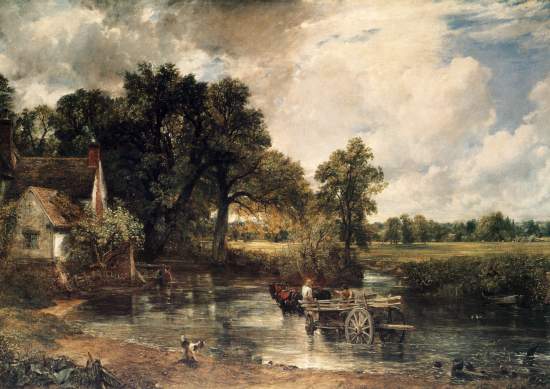
The Haywain by John Constable, is probably one of the most famous of all English
paintings. Many a home has a print, but relatively few people know the story behind
it.
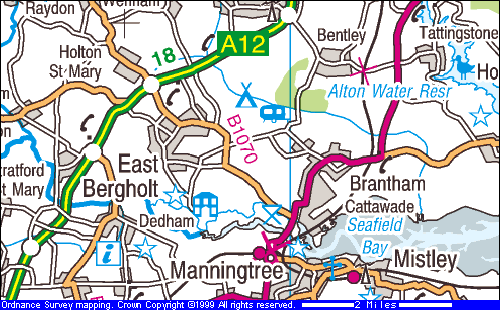
John Constable was born in East Bergholt, Suffolk, England on 11th June 1776.
Initially his father, Golding Constable wanted young John to join him is his prosperous
corn business. By 1799 however it was obvious that John loved nothing more than
drawing, so he was given an allowance to study at the Royal Academy in London.
The art world was slow to recognize his talents. Landscapes were not considered
very important in his day, so he had to produce a few portraits for his income.
He would often spend his Summers in East Anglia, making sketches ready for them
to be transformed into his beautiful works when he returned to his home in London.
During these early years he created such works as Boatbuilding near Flatford Mill
(1814-15) which can be seen in the Victoria and Albert Museum in London.
In 1819 he moved to Hampstead Heath on the outskirts of London. By this time
his father had died, so he was more financially secure. He was now producing his
best work, including The Haywain in 1821. The work was based on many sketches
he had produced, many of which still survive. In 1824 The Haywain was exhibited
in Paris, where it won a gold medal. The painting caused a stir amongst the French
art critics, who were astonished by its freshness. In his later years he lectured,
still trying to popularize landscape painting, but he died in 1837 with none of
the fame he now has.
The Scene Now
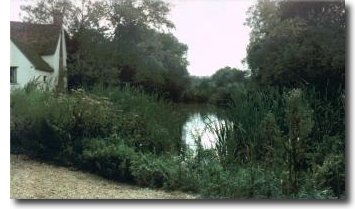
In the Autumn of 1993 we went to East Bergholt in Suffolk to see for ourselves
where this great work of art was set. The river bank is now overgrown, but it
is easy to imagine the great artist seated with Willy Lott's Cottage on his left,
Flatford Mill on his right and the wonderful Suffolk landscape before him.
A large collection of John Constable's works can be seen in the Victoria
and Albert Museum, but The Haywain itself is in the
National Gallery in London, England.
Read more...
Constable - Michael Rosenthal
Michael Rosenthal clears away the myths to reveal the aims and motives behind Constable's paintings. His work is discussed against the background of a complicated episode of British history.
John Constable: The Man and His Art - Ronald Parkinson
Both an introduction to John Constable's life and a companion to the Victoria and Albert Museum's collection, this book ranges from his early years at the Royal Academy, through his relationship with fellow artist, William Turner, to his last years in Hampstead. The Constable Collection at the Victoria and Albert Museum, much of which was the gift and bequest of the artist's daughter, is the largest and most comprehensive anywhere. It is particularly strong in preparatory studies which give an insight into the creative process, and provides a view of how some of Constable's major masterpieces came into being. The book is illustrated throughout in colour with key paintings and drawings and details which reveal Constable's mastery of technique.
Constable: Impressions of Land, Sea and Sky - Anne Gray, John Gage
Here is a sumptuous, full-colour catalogue of the exhibition showing at the National Gallery of Australia from 3 March - 12 June 2006. It includes the entire catalogue of 108 works, many supplementary images and six illuminating essays by the exhibition's curators and Constable scholars. It also features 47 images and catalogue of a group of 13 Australasian artists who were influenced by Constable.